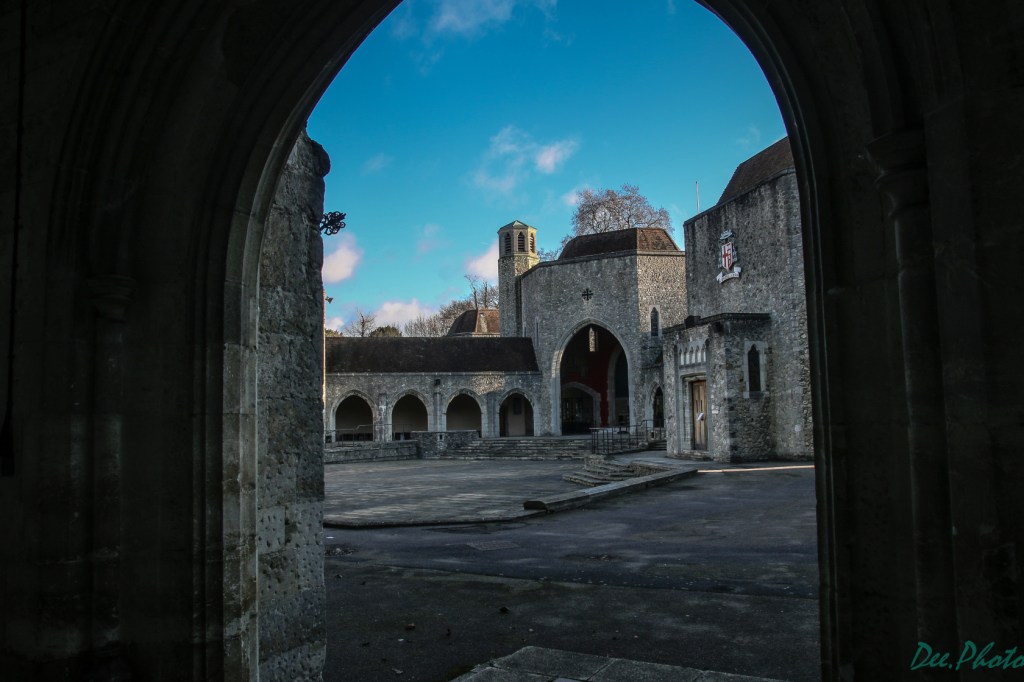
I have little in common with religion, I have to admit it, but I have always respected the faith and devotion of other people to different religions around the world. I am fascinated by buildings that were created out of people’s love and admirations for various gods.
Today I want to tell you about the monastery that I visited recently. It impressed me, for two reasons: because of the beauty and history of this place and because of Adam Kossowski, the Polish artist who helped renovated it.


Carmelite orders are known for their inaccessibility and mystery of the places where they settled, they are one of those contemplating, hermitic places where monks seek God among nature. The first of these monasteries appeared in Palestine, on Mount Carmel. Hence the name of the order. Following the example of the prophet Elijah, various types of hermit were hiding here alone to contemplate their devotion to God. They came from all over the world. By indulging in their prayers they were happy. Unfortunately, the political situation in Palestine became turbulent at the beginning of the thirteenth century, and hermits were forced to leave Mount Carmel. Some who were brave enough to stay there were murdered. Few of the Carmelites went to Cyprus, and the other group to England. Here in 1243, among the riverside forests, they founded their new home, Aylesford Monastery. It developed dynamically for centuries. Unfortunately, in 1538, by decree of King Henry 8, all orders were dissolved in England. The buildings in Aylesford went to secular dignitaries. Only after the war in 1949 the old, ruined buildings of the priory were put up for sale and Carmelites were able to buy back their native nest. The brothers immediately started renovating the temple and apartment buildings. The new Prior decided to make the monastery a place of pilgrimage. He was a visionary and ordered the construction of open temple, like the used to have in ancient Greece, with the altar outside so it could fit as many people as possible.


A beautiful statue of Mary by Michel Clark was placed behind the altar. One of the artists employed in the reconstruction of the temple was Adam Kossowski, born in Nowy Sącz in south of Poland. He studied art in Warsaw and Krakow, but traveled around many countries mostly Italy and France learning the secrets of painting and sculpture.
When the war broke out, he joined the army and fought on the Eastern Front, but, unfortunately, he was captured and sent to the gulag, where he spent over 3 years. The Polish army under general Anders liberated this prison. Adam exhausted and sick was not fit for further fight, and was sent to London via Palestine. The conditions in the Gulag were inhuman and as he mentioned, he prayed earnestly to God. He promised him that if he ever will be free he would devote himself entirely to creating art for the glory of God. He kept his word.
At Aylesford Priory you can see both his paintings and amazing art created from ceramics. Initially, Kossowski was ordered only a few tempera paintings depicting the history of the Carmelite Order in Aylesford, but later he was offered a completely different project. There was a ceramic workshop in the monastery, referring to the history of the region, where the first potter’s wheel and ceramics from pre-Roman times were found. Abbot of the monastery Father Malachy asked Kossowski to create small altars from ceramics for the Rosary Way. While Kossowski felt confident in painting in tempera, he didn’t believe he could create anything decent from clay. The abbot did not give up, knowing the story of Kossowski, he told him: “Saint Mary had a reason to send you here”.
And look at these photos, i think he created something amazing:


Another examples of his work in Priory is the mosaic from ceramic tiles depicting the story of Saint Simon Stock one of the prior of the Aylesford monastery. This work is exhibited in the northern chapel. In the main chapel, the whole wall behind the statue of Maria is the work of a Kossowski. In the gardens, the artist made 12 stations of the cross, like he has seen in churches in Polish Mountains.


Kossowski, under the patronage of Father Malachy, created over one hundred works for the abbey, he worked here practically without interruptions, in the years 1960-1971. His ceramics, tempera, iron works, stained glass can be found throughout the abbey. He had the opportunity to fulfill himself artistically and mystically. His work in Aylesford extends from the tiny painted stations of the Rosary Road in the chapel of St. Judy, to the impressive multitude of angels surrounding the Virgin outside at the altar of the Sanctuary. Everything in the artistic style, which, refined in design and expressive in performance, is largely based on the naivety of Polish folk art and the forgotten tradition of Romanesque art. This style seems appropriate both for the dramatic depiction of worshiping angels huddled around the main altar, or the expressive chariot of fire of Elijah in the chapel of St. Joseph, and to show the delicacy of the Rosary Way. Working in clay gave Kossowski the opportunity to create a three-dimensional effect as well as depict the movement.


Crowds of pilgrims on their way to Canterbury come to Aylesford Priory every year and the brothers do not refuse anyone a place to sleep or a meal.


 Discovering Kent
Please share with me what you think.